
 Should you have any dreams about becoming rich as a composer, it might be helpful to know who makes what in the music publishing business. And be sure you read to the end because I’ve updated this post since it was written 6 years ago. Now mind you, I’m not saying you can’t make a living composing music (that’s a subject for a later post), but its surprising how often students, teachers, and aspiring composers don’t know how much a composer makes on each piece of music! Unless you are a composer in high demand for which publishing houses are beating down your door trying to sign you on, then you should be aware of how how the money is distributed in the print music industry.
What Makes What in Print Music Publishing
1. Percentages
Publishing company: 50% of the price of the item (of course they have the bulk of the fixed expenses, while the composer has the bulk of the initial time in the project.
Retailer: 40% of the price of the item. So if you bypass the music store or distributor and buy directly from the publisher, that extra 40% goes directly to the publishing company. None of this is distributed to the composer.
Composer: 2% to 10% of the price. Ten percent is actually a high figure in pedagogical music believe it or not. This is not to say that this is unfairly high, but that it’s the most a publisher is usually willing to give to the composer.
So, for the piece of sheet music that you buy at $3.50, the composer gets 35 cents! Let me write that again: $0.35! For the book that costs $6.95, the composer gets seventy cents: $0.70. Sometimes royalties are as low as 2-5%. In my experience, the smaller publishing companies (especially the sacred ones I have dealt with) are the best about consistently paying the composer 10%.
2. Buying music on sale
Discounts made by retailers do not hurt the composer’s royalties. The retailer is giving up some of their 40% profit when they offer the book at a discount.
3. Complimentary Copies
Composers are not paid any royalties for music that is given away at conferences or are part of complimentary packets at clinics. So, if you want to help a composer, please use those complimentary copies as reference copies, and then purchase the music at the music store.
4. Arrangements
Composers who arrange pop music are typically not paid royalties, but rather have contracted with the publisher to write the pieces for a certain price. Compared to the volume of sales that are made on pop books, this price is usually very low.
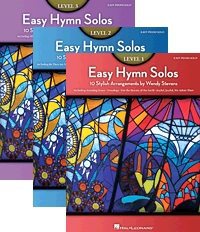 What about public domain tunes that are arranged? It depends. The sacred publishers (places like Hope Publishing, Concordia, Augsburg Fortress) are good about recognizing that these are pieces of art themselves (not just a melody over chords), so they are good about giving the typical 10%. However, that is not always the case with the larger publishing companies in my experience.
Guess what I get for my Easy Hymn Solos series (picture on the right)! Read to the end to find out.
5. Pro-rata share
If the composer’s work is a part of a collection of original pieces, the 10% royalty is divided by the number of pieces in the book or amongst the contributing composers. So, if I write 2 pieces in a book that has 8 pieces in it and the price is $6.95, then my share is $0.18 per book that is sold (25% of .70). Sometimes the 10% is divided among the number of authors, not based on the number of pieces that each has contributed. So, for a book in which there are 4 composers, and I write 3 pieces, then my share will still be $0.18 (the $0.70 divided by 4).
Summary
Though the composer is one of the main players that enables the publishing company to exist, they get a very small percentage of the sales made. It is easy to get discouraged in the industry when you see all of your time and effort and little payment.
If there were one thing I would suggest to teachers that would help composers remain in the industry (to keep them from being so discouraged they quit and therefore new music disappears!), I would encourage them to refuse to copy music! Every time music is copied, that means less royalties are paid to the composer. Those royalties can really add up and make a difference to a struggling composer. In addition, when a publisher is looking at which composer’s works are popular to give and want to give a new job to a popular composer, than the number of pieces that are sold (rather than copied) make a difference.
To future composers, I hope this is not discouraging. However, I think you should enter the publishing business knowing the facts. I’ll write about how some composers “make it” in the business in a later post.
Hope this sheds a little light on the industry! If you are a composer who has different contractual arrangements than the ones mentioned, please let me know so that I can make this post as thorough as possible.
Of course, since this post was originally written in 2009, a lot has changed since then. Let’s just say, “Can you see why composers are motivated to try to publish and sell on their own?” Yes, it’s a ton of work, and if you aren’t particularly good at editing, marketing, printing, distinguishing yourself, etc., then self-publishing is not worth it. Publishers are great at being able to offer the composer the entire package. But, you can see why some composers are becoming more motivated to learn to do these things on their own, yes?
Thoughts?
Oh yes, I’ll tell you that I get 5% for my Easy Hymn Solos books. So, when you purchase one of the books (that’s 10 carefully and creatively crafted arrangements) for $7.99, I get forty cents. $0.40.

Wow, this is really informative. I didn’t realize that the composer’s percentage was so low.
Yes, it’s true. I would love for you to help spread the word about this. I fear that if the percentage continues to go lower, composers will have little motivation for composing any music except that which they really want to compose. So, perhaps if more teachers and students know these facts, the more they’ll refuse to copy music and perhaps will even demand a change in the system!
Hi, nice posts there 🙂 through’s for the intriguing information
Wow! I had no idea. My piano teachers were always very strict about the no-copies rule, and now I know why! Good to know!
Glad its informative!