
Fantastic Article on “Imagine: How Creativity Works”
I rarely pre-order a book, but the new book by Jonah Lehrer Imagine: How Creativity Works intrigues me enough that I pre-ordered today. It’s set to be released in just days, March 19th. I read the very interesting essay How to Be Creative by the author in the Wall Street Journal and wanted to share a few of the highlights, though I hope you’ll take time to read it too.
We already know that the idea of some people being “creative types” and others not is a myth. But Jonah does more than merely dispel the myth, he talks about the new science of creativity. He suggests that there are practical things we can do to get the creative juices flowing depending on whether we need sudden insight or stick-to-it late nights at the office. One of my favorites, mostly because I know it to be true from experience, is his suggestion for prompting creativity:
For prompting creativity, few things are as important as time devoted to cross-pollination with fields outside our areas of expertise.
He tells the familiar story of Arthur Fry, the engineer at 3M that came up with the idea of post-it notes. I’ve heard a short version of the story many times, but never all the details that Lehrer shares, about him being a member
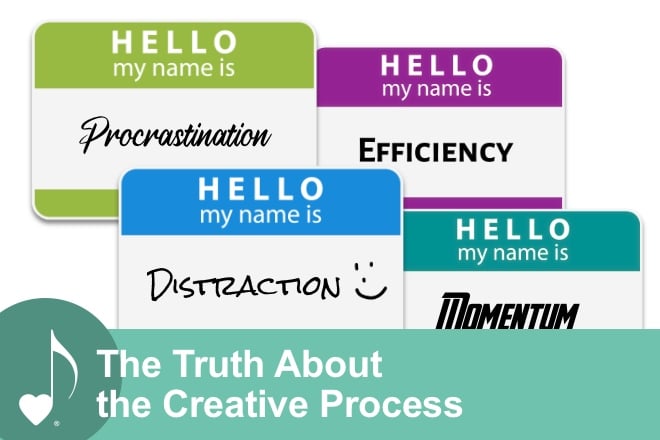
Read MoreCreativity Traded for Efficiency
If you are interested at all in the concept of creativity, you need to read this Wall Street Journal article, “Chains That Set us Free.” Now, there have been any number of articles, musicians, and all kinds of creatives that talk about the benefits of setting limits when attempting to be creative. But, none have put it in such a way that really explained why boundaries are necessary for our brains to be most creative. Jonah Lehrer says,
The larger lesson is that the brain is a neural tangle of near-infinite possibility, which means that it spends a lot of time and energy choosing what not to notice. As a result, creativity is traded away for efficiency; we think in literal prose, not symbolist poetry.
“Creativity is traded away for efficiency.” Wow, I’ve humorously labeled myself an efficiency guru. I’m always looking for the fastest route to the next destination (which is sometimes annoying I’m told), the most efficient way of covering teaching material at a lesson, etc. So, it makes perfect sense to me now why, when I am sitting down to compose something for my students, I am paralyzed unless I know what I am writing about. Knowing what technical skills of pianists I am writing for is also helpful, but not nearly so helpful as knowing what I am writing about. If it’s a pirate, I am so much more efficient finding piratey sounds. If it’s a rainbow, then my creativity is efficiently channeled to a certain type of sound. If it’s a piece for a string quartet, then at least some of those pathway searching neurons can be more effectively channeled.
I’ve wondered whether needing to know my subject or at least some boundary is a weakness or a strength, but I’m happy to realize that its just a part of the process of efficiency that helps me establish boundaries and find creativity in those boundaries. Anyone else have these needs to find
It’s a great article, so don’t forget to read.
Read MoreOn Creative Work by Ira Glass
Here’s some good advice and things to remember from Ira Glass, the host of This American Life.
Read More
Must Art Teach a Lesson?
I have read many theological discussions and defenses of the arts, and I am always torn in my response to them. For one thing, it saddens me when we feel the need to justify art by making it serve some other non-artistic purpose like teaching morality. But also, many of these defenses of art (think of Christian justifications for fantasy) seem to be afflicted with excessive seriousness, even self-importance. Do I believe that art can be a catalyst for social change, a commentator on the human condition, a conveyer of truth, a powerful agent of transformation in people’s lives? Yes! But to have to go about our business as artists while wearing that heavy mantle of responsibility seems crippling to me.
- Jennifer Trafton in the very fine essay, “The Art of Play.”
Read MoreThe End-of-Project Sharing Element
Do you ever wonder why there isn’t more excitement about what you think are fun projects in your studio? Shouldn’t art projects, composing their own music, sight-reading challenges, etc. be thrilling for students?
I’m reading a book called Using Technology to Unlock Musical Creativity and the author Scott Watson talks about 8 principles for unlocking music creativity. I think his principles are fantastic and every teacher should read the book to improve their teaching. Just now I was struck by principle #8 just now where he states,
One of the best ways to ensure that students are motivated to work earnestly toward a good end product is to include an end-of-project sharing element into the plan…During these presentations students can share the fruits of their labor and feel a sense of celebrity for their creative efforts.
I think that the reason that more students aren’t interested in creative music projects is that there is no end-of-project sharing that is promised. I’ll give you an example.
Read MoreBoredom and Curiosity
Here’s a great thought to follow-up the post: Why Are Adults Less Creative?
‘I’m a big believer in boredom,’ [Steve Jobs] told me. Boredom allows one to indulge in curiosity, he explained, and “out of curiosity comes everything.” The man who popularized personal computers and smartphones — machines that would draw our attention like a flame attracts gnats — worried about the future of boredom. ‘All the [technology] stuff is wonderful, but having nothing to do can be wonderful, too.’
- Steve Jobs 1955-2011 (courtesty of Gina Trapani)
Read More


Follow Us!